This is a researched guide, based on published product information and practical planning. It is not a hands-on product test. Check the exact model and its current instructions before buying.
Measure each board from its outermost points
Collect the boards that need a home and separate daily cutting boards from occasional serving pieces. Measure overall length, width, and the thickest part, including any feet or raised grip. For a round board, record the diameter and handle projection separately. Note where you can comfortably hold it when removing it.
For a hypothetical board with a 15-by-11-inch body and a handle projecting another 3 inches from one short end, the overall length is 18 inches. A 16-inch-deep cabinet will not accept that length straight front to back. Turning it may help only if the full width and removal path also fit.
Give rectangular and round boards appropriate support
A slot that accepts a thin rectangular board may be too narrow for a thick wood board, while a round edge needs support that suits its shape. Check the holder's stated board limits and where the board actually rests. Do not assume a pot-lid rack supports every board simply because its gaps look adjustable.
Yamazaki's US page for the Tower Round Cutting Board Stand lists accommodation for round boards up to 14 inches in diameter or rectangular boards up to 1.4 inches thick. These are model-specific limits, not a universal fit rule. A compatible thickness still leaves the loaded height, handle clearance, and available counter space to check.
Choose a home that leaves a straightforward grip
On a counter, mark the holder's footprint and add the board extending beyond it. Check the space underneath any wall cabinet and the route toward the work surface. In a cabinet, make sure the grip remains reachable and the board can pass the frame without pushing aside a pan or scraping a hinge.
Place the largest board first, then try the smaller ones beside it. Remove the daily board while the others stay in place. If the holder or neighboring boards move, reconsider that combination. A heavy board should have a position you can reach and control comfortably, rather than an overhead slot chosen only because it is empty.
Separate cleaning, drying, and the final return
Leave an appropriate place for a cleaned board to finish drying before it goes into a close cabinet or against other stored boards. Follow the board manufacturer's instructions for its material and construction. John Boos's wood-board care guide describes towel drying followed by air drying while standing up, and storage in a dry, ventilated area.
That guidance does not make an arbitrary bookend or improvised stack a suitable drying support. Use a stable arrangement intended for the board's shape. Check the holder's care separately: Yamazaki does not recommend putting the cited stand in the dishwasher. Cleaning instructions for a board and its stand may differ.
Keep only the arrangement that works after a normal meal
Rehearse the full sequence: take out a board, use the work area, clean and dry it according to its instructions, then return it without rebuilding the cabinet. Keep occasional serving boards elsewhere if their handles dominate the daily setup. Leave a visible place for the board even when it is being washed.
Skip a new holder if your existing arrangement supports the boards appropriately and leaves them easy to remove. Also skip a narrow stand that fits the slots but creates an awkward loaded shape on the counter. Buying a new matching board set is unnecessary when a smaller change can accommodate the boards already used.
Compare a researched example
Use the guide to check your space, then compare the exact product's measurements and limitations.
Our linked product picks include paid Amazon links. We may earn a commission if you buy through those links.
A quick visual checklist
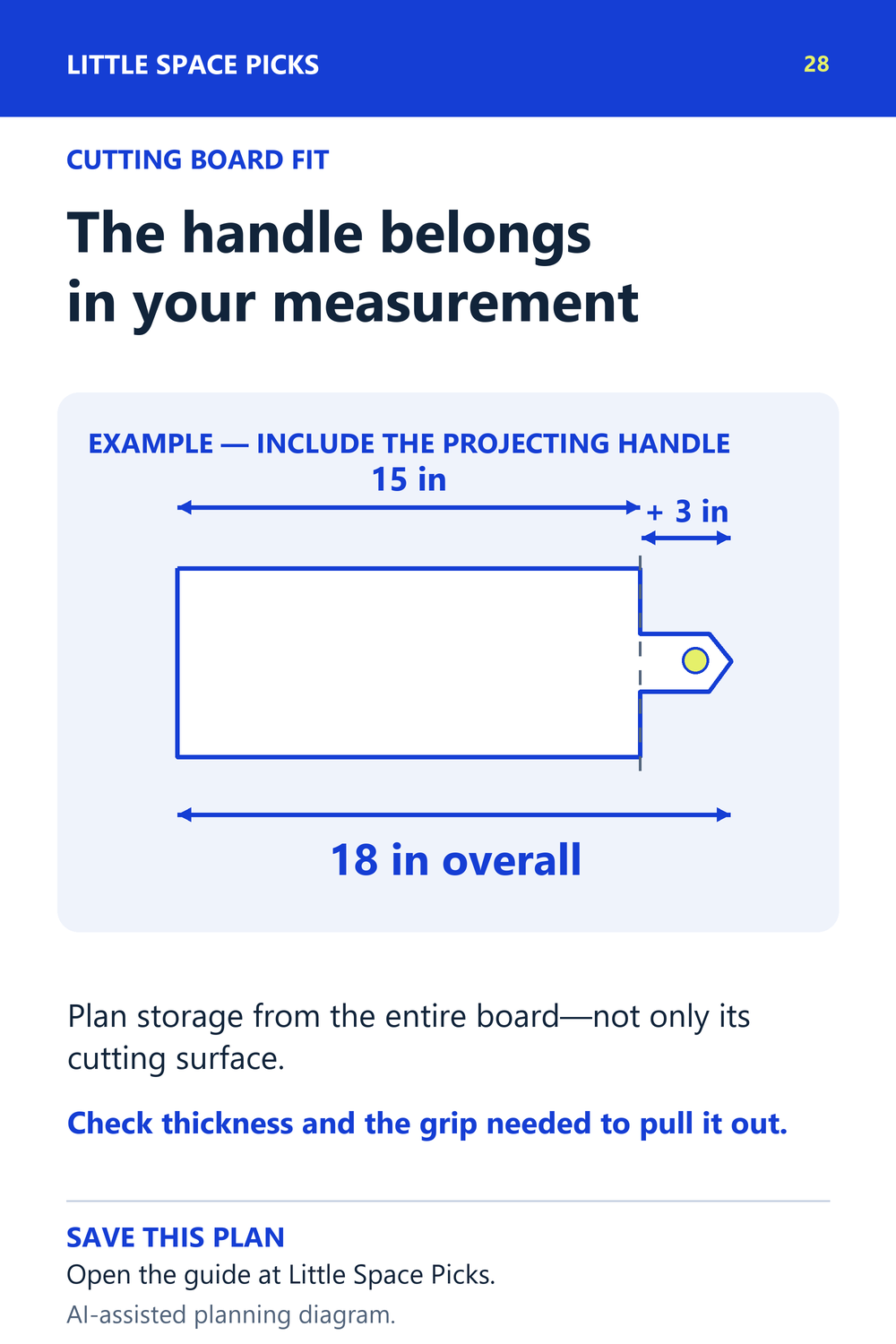
An original Little Space Picks planning diagram. Download the checklist.
Sources & further details
- Yamazaki Tower Round Cutting Board Stand — board size limits and care
- John Boos — wood cutting-board drying and storage guidance
Sources checked October 5, 2026. Model details and installation guidance can change.