This is a researched guide, based on published product information and practical planning. It is not a hands-on product test. Check the exact model and its current instructions before buying.
Choose one drawer job and check the real clearance
Empty the drawer and decide what it should hold: everyday shirts, workout clothes, underwear, or another useful group. Separate clothing that belongs elsewhere before dividing the space. Measure the inside width and depth, then check the lowest point along the drawer's closing path rather than relying on the height of its front.
Note any rear brace, handle screws, or curved drawer sides that reduce usable room. Open the drawer as far as it normally travels and check how much of its back remains under the furniture. Put frequent choices where you can see and reach them in that normal open position.
Use a fold template as a guide, not a rigid rule
Fold a typical garment into a shape that suits the drawer. A clean piece of card can help repeat the width while folding; remove it before storing the clothes. Try the same width with a thicker item and a smaller one. Adjust the folds if the packets become too tall or need to be compressed to fit.
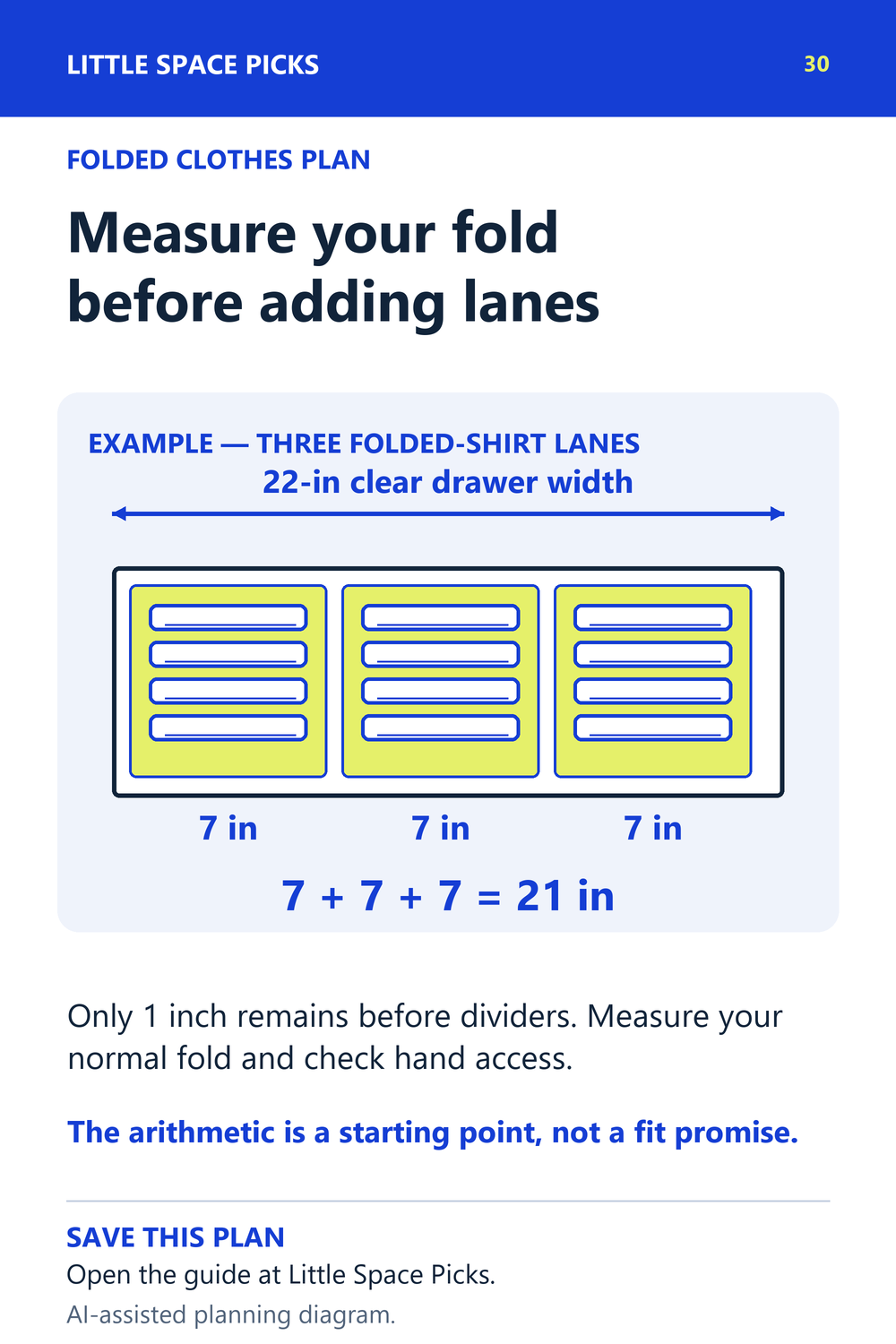
For a hypothetical 22-inch-wide drawer, three lanes of 7-inch-wide folded shirts use 21 inches. That leaves 1 inch total before adding divider walls or container thickness. This is a starting layout, not proof that three boxes fit. Measure the clothing as placed, then compare the outside dimensions of any organizers.
Choose rows or short stacks by how you retrieve clothing
Upright rows can make individual shirts visible when the folded packets remain supported. Short flat stacks may be simpler for items that do not hold the chosen upright fold. Try both with several real garments and remove one from the middle. Keep the arrangement that requires less rebuilding.
Give small items a broad compartment if they migrate into neighboring groups. Avoid assigning one tiny cell to every garment when ordinary laundry changes the quantity. A useful divider keeps categories separate without demanding that every sock, shirt, or pair of shorts has exactly the same folded dimensions.
Check organizer height and care before buying a set
A fabric box can look forgiving while still being taller than the drawer's closed clearance. IKEA lists its SKUBB set of six boxes at a height of 5⅛ inches, with two each in footprints of 5½ by 5½, 11 by 5½, and 11 by 11 inches. Compare those assembled sizes, not the flat package measurements.
Do not plan on squashing the sides or overfilling a box to make the drawer close. Allow for the actual clothes above its rim as well. IKEA specifies vacuuming or a lint roller for these boxes and says not to wash them, so choose them only if that cleaning method fits the drawer's use.
Test the drawer when all the laundry is back
Load the normal clean quantity, including the thickest items, and gently close the drawer. Stop and adjust if fabric catches, rubs, or needs to be pressed down. Remove a few garments, then return them as you would after laundry. A layout that works only when half the clothes are elsewhere has not passed the useful test.
Leave some flexibility for changing quantities instead of packing every lane tightly. Skip new boxes when the folds already stay in place and categories remain clear. Also skip an insert set whose fixed compartments force awkward folds. A small divider, a simpler category, or moving occasional clothing may solve the problem without filling the drawer with containers.
A quick visual checklist
An original Little Space Picks planning diagram. Download the checklist.
Sources & further details
Sources checked October 5, 2026. Model details and installation guidance can change.