This is a researched guide, based on published product information and practical planning. It is not a hands-on product test. Check the exact model and its current instructions before buying.
Match the bracket to the actual door
Measure the door’s thickness where the bracket will sit, including any trim or molding at that point. A cabinet door and a room door may need different hardware. Use the product’s stated fitting range rather than a phrase such as standard door.
When a listing gives inconsistent measurements, ask the manufacturer which specification applies to the exact version. The Umbra Estique page, for example, includes slightly different door-thickness figures in its description and feature text. A close fit needs confirmation rather than rounding in the buyer’s favor.
Check the space above the door
The door-to-frame gap has to accommodate the bracket while allowing the door to close normally. Inspect whether a seal or trim occupies that space. Do not plan to force the latch or scrape the bracket past a tight frame.
After installation according to the instructions, test the empty organizer gently before loading it. Stop if the door binds. The storage gain is not useful if closing the door becomes difficult or causes repeated contact with the frame.
Allow for the loaded depth
Measure how far the organizer projects, then add the bulk of what will hang on it. A folded towel, a backpack, and a flat scarf create different shapes. The product’s bare dimensions do not describe a fully loaded door.
Check the door handle and nearby switches too. Hang a paper outline at the proposed position to spot obvious conflicts. In a bathroom, consider whether the loaded rack intrudes into the space you use beside the sink or while entering the room.
Follow the door through its swing
Open the door slowly through the movement you normally need. Look behind it: a hook or basket can meet the wall long before the door handle does. Check neighboring cabinet fronts, mirrors, and anything fixed along that path.
For cabinet storage, verify that the organizer clears interior shelves when the door is shut. A basket hanging comfortably on an open door can collide with a shelf edge as soon as the hinges begin to close. Test with the intended items in place.
Load for the product and the routine
Read the organizer’s overall and per-hook limits, and follow all mounting instructions. Do not multiply a per-hook figure into an assumed door-wide capacity unless the manufacturer explicitly permits that interpretation. The door and mounting method also need to be suitable.
Put frequently used items where they are easy to grasp and return. Keep straps from trailing across the floor or catching the latch. Follow the supplied guidance for protective pads; adding arbitrary thickness under a bracket can change its fit. Recheck the movement after loading, since bulky contents are often what reveal the final clearance problem.
Compare a researched example
Use the guide to check your space, then compare the exact product's measurements and limitations.
A quick visual checklist
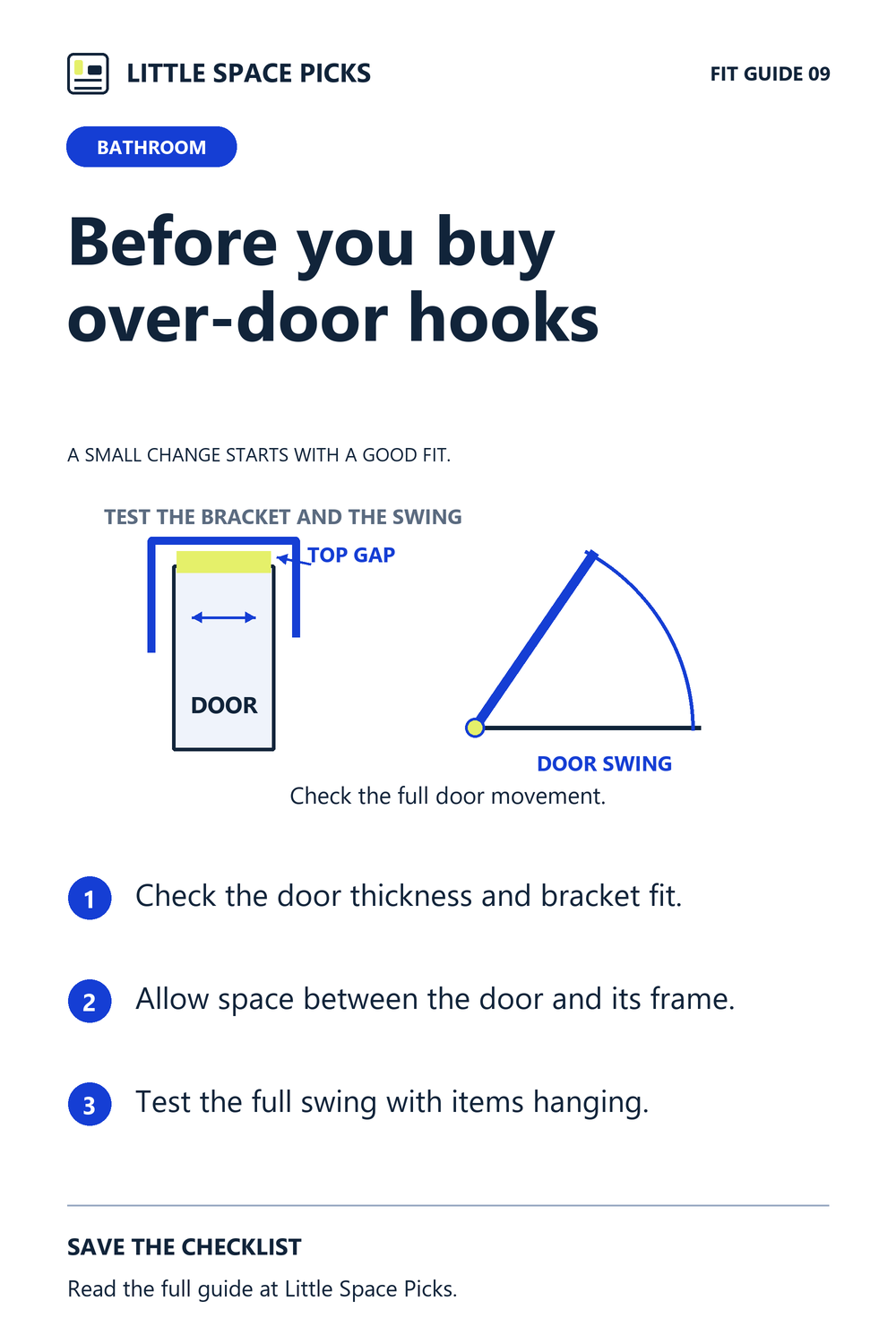
An original Little Space Picks planning diagram. Download the checklist.
Sources & further details
Sources checked October 4, 2026. Model details and installation guidance can change.