This is a researched guide, based on published product information and practical planning. It is not a hands-on product test. Check the exact model and its current instructions before buying.
Identify which bed each piece actually fits
Sort fitted sheets, flat sheets, duvet covers, and pillowcases by their labeled sizes and the beds currently in your home. Separate unmatched pieces for a deliberate decision rather than hiding them under complete sets. If two rooms use the same size, you can group by size instead of assigning every set permanently to one room.
Write simple labels such as 'Queen: main bedroom' or 'Twin: spare bed.' Avoid labels based only on color when several sets look similar. Decide how many complete changes you want available for the way you do laundry and host guests; there is no single count that suits every household.
Measure an actual folded set
Fold a set the way you are willing to fold it after laundry, including its pillowcases. Measure the resulting width, depth, and height without squeezing it unnaturally flat. Repeat for the bulkiest set. An organizer should work with your routine, not depend on perfect folding.
For a hypothetical 24-inch-wide shelf, two folded bundles each 11 inches wide occupy 22 inches. That leaves only 2 inches total before adding divider thickness or container walls. Put the bundles on the shelf and check hand access; the arithmetic alone does not prove that two boxed sets will be comfortable to retrieve.
Assign shelves by frequency and reach
Keep the next bed-change sets within comfortable reach. Give occasional guest linens a separate labeled position, and keep bulky seasonal pieces apart from the regular sheets. Avoid making a tall stack that must be dismantled whenever the bottom set is needed.
If a deep shelf encourages a hidden second row, put a clearly labeled occasional-use group behind the daily group only when you can remove the front group easily. Otherwise, leave some back space unused. Filling every inch is less useful than knowing exactly which sets are ready.
Choose containers after checking shelf depth
Open bins can gather complete sets; dividers can separate stacks without enclosing them. Zipped cases suit a distinct seasonal group when you have a suitable place for the full case and can remove it to open it. Do not assume all products called linen storage fit a shallow closet.
For example, IKEA's SKUBB case 705.910.61 measures 25½ inches wide, 20¾ inches deep, and 7½ inches high. Its regular rectangular footprint will not fit completely on a 24-by-18-inch shelf in either orientation. IKEA specifies vacuuming or a lint roller for cleaning this case and says not to wash it.
Make returns as simple as retrieval
Keep each set together in its assigned space, using a loose pillowcase bundle if that fits your folding routine or a labeled compartment if it does not. After laundry, return clean, fully dry linens to that group. Keep the label visible after the shelf is refilled.
Skip new bins when stable, labeled stacks already let you take a complete set without disturbing the others. Also skip a case that must be tightly stuffed or wedged past the closet frame. If the space remains crowded, revisit unused sizes and seasonal quantities before buying containers for every piece.
A quick visual checklist
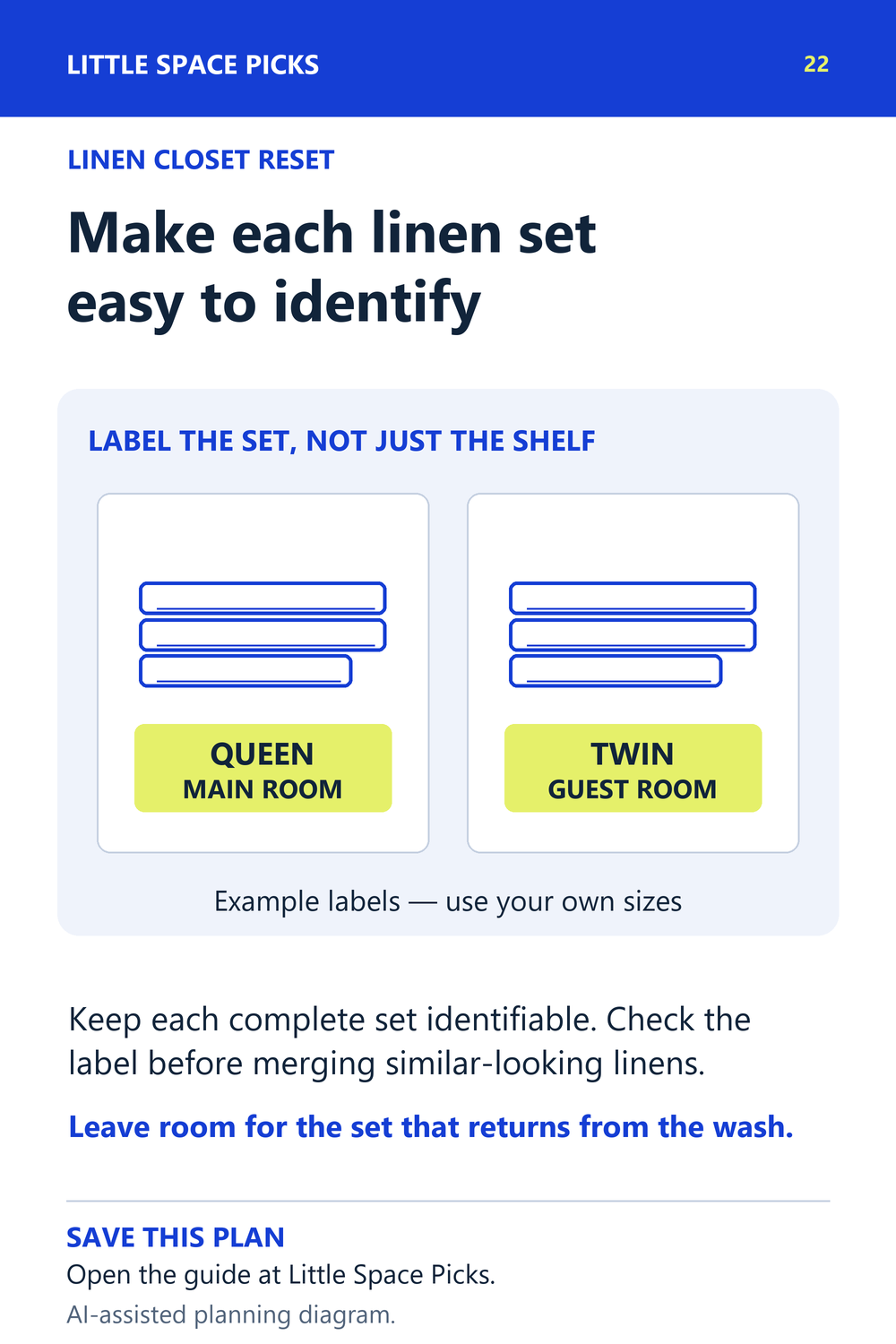
An original Little Space Picks planning diagram. Download the checklist.
Sources & further details
Sources checked October 5, 2026. Model details and installation guidance can change.